CNESST First Aid Kit: What the Regulations Require Since 2026
Le 2026-09-10


Since 12 February 2026, what must go into a first aid kit in Quebec is no longer described item by item in the regulation: it must comply with CSA Z1220, Workplace First Aid Kits. The company therefore chooses the type and number of kits based on its risks and headcount, then keeps every kit clean, complete and accessible at all times.
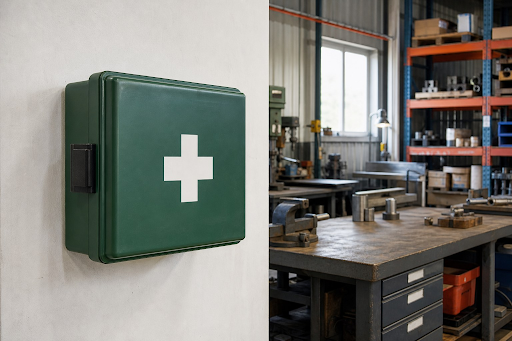
A portable, compartmentalised container marked with a cross: the regulation’s own definition.
The Regulation respecting minimum standards for first aid and first aid kits defines a kit as a portable container divided into compartments, the outside of which bears a cross and the words “first aid” in easily legible characters. This detail looks cosmetic, but it is part of the text: a toolbox filled with bandages does not meet the definition.
Section 4 then imposes three things on the manager of an establishment: an adequate number of kits, easy to access, as close as possible to the work areas, and available at all times. Supply and contents must comply with CSA Z1220. This is the structural change of 2026: the list of supplies is no longer in the regulation, it lives in a pan-Canadian reference maintained by the Canadian Standards Association.
That reference classifies kits by type (personal, basic, intermediate) and by size, according to the number of people served and the risk level of the setting. The regulation follows this logic when it requires, for example, a type 1 container in certain vehicles and a large-format type 3 (intermediate) kit in the first aid room of the settings covered by Division IX.
The regulation does not give a single figure: it gives a performance criterion. In an establishment, kits must be close to where the work actually happens and accessible at all times. On a construction site, section 8 is more specific: the site has an adequate number of kits when the time required to reach one is about 5 minutes for all workers. This 5-minute criterion is the best practical test, even away from construction sites.
Vehicles used to transport staff or for their use, and travelling where no kit is accessible, must also be equipped. The minimum contents rise to the section 4 level when the vehicle’s capacity exceeds 5 people and the crew is more than 30 minutes from a medical service. Otherwise, the type 1 format under CSA Z1220 is sufficient.
Three maintenance and identification obligations complete the picture: every kit must be kept clean, complete and in good condition (sections 6 and 10), adequate signage must allow the kits and the communication system to be located quickly (section 13), and the workplace, position, first and last name of the first aiders must appear on a visible notice (section 14). On a construction site, the first aider is instead identified by a helmet marked with a cross.
Regulation respecting minimum standards for first aid and first aid kits, in force since 12 February 2026
| Setting | Workers present at the same time | First aiders required |
| Establishment | 50 or fewer | 1 |
| Establishment | each additional hundred or fraction | +1 |
| Construction site | 10 to 50 | 1 |
| Construction site | each additional hundred or fraction | +1 |
| Forestry operation | 5 or fewer | 1 |
| Forestry operation | 6 to 10 | 2 |
| Forestry operation | more than 10 | 2 + 1 per group of 5 |
The number of first aiders required by setting and by headcount present at the same time.
Equipment is worth nothing without someone to open it. In an establishment, section 3 requires the presence at all times, during working hours, of at least one first aider when 50 people or fewer are present simultaneously, then of one additional first aider per additional hundred or fraction of a hundred. The calculation excludes anyone present for less than 30 minutes.
Other settings have their own grid. On a construction site employing 10 to 50 workers simultaneously, the principal contractor must provide one first aider, plus one per additional hundred. In forestry operations, the new section 6.1 is considerably tighter: 1 first aider for 5 workers or fewer, 2 first aiders for 6 to 10 workers, then 2 first aiders plus 1 per additional group of 5 workers.
The regulation also governs the training itself. The certificate is issued by an organisation recognised by the Commission, to a person who has acquired the competencies of the CSA Z1210 standard at the intermediate level, with a practical demonstration of skills. Its validity is 3 years at most. Our first aid programs and our on-site corporate courses are built on this framework, and our article on the obligations tied to CPR training in Quebec covers the resuscitation side.
The question comes up in every annual budget. Section 18 is unambiguous: management, or the principal contractor on a construction site, bears the costs of setting up and maintaining the facilities provided for in Divisions II to VII. This covers the containers, their stocking and the communication system.
Section 19 adds two protections for the person designated as first aider. They may take time away from work without loss of pay for the time required to obtain or renew their certificate. Their travel expenses are covered by the company insofar as the course or refresher is offered no more than 40 km from the establishment or site. That is a concrete argument for training on site rather than sending a team travelling.
Many companies are compliant on the equipment side and have no register at all. Yet section 15 requires the first aider who intervenes to complete a report containing their name and that of the injured worker, the date, the time, a description of the injury or illness and the nature of the care given. This report is given to management or the principal contractor, who keeps it in a register maintained for that purpose. Section 16 specifies that any information concerning a worker must be accessible to that worker.
This register replaces nothing: section 17 is a reminder that obligations in the event of an employment injury, in particular the notice of accident and the medical assistance provided for by the Act respecting occupational health and safety, remain fully in force. In practice the register serves two purposes above all: tracking the minor incidents that foreshadow a serious accident, and proving that equipment was used and restocked.
Above 100 workers, the employer of an establishment or the principal contractor of a construction site must set up a room where the first aider can provide first aid, available and easy to access at all times during working hours, and kept clean.
The settings covered by Division IX go much further. They must keep a nurse on site and set up a heated first aid facility, with water and sanitary installations. The regulation lists very specific equipment for it: portable oxygen therapy equipment capable of delivering medical oxygen at a variable flow rate of 15 litres per minute for at least 25 minutes, oropharyngeal airways from 40 mm to 110 mm, a backboard of at least 183 cm by 40 cm supporting a load of at least 182 kg with a minimum of 10 anchor points, a large-format type 3 kit plus the contents of an additional kit, and one further kit per hundred workers above 200 people present simultaneously. Administering oxygen requires separate training, such as our oxygen administration course.
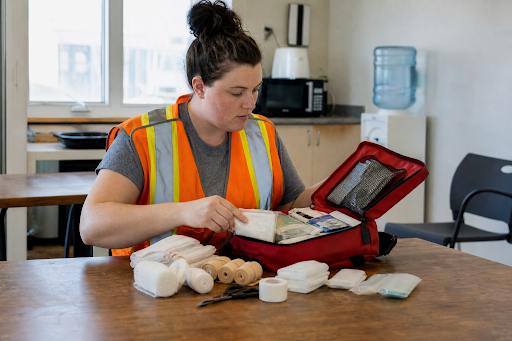
A documented quarterly inspection is the easiest proof to produce.
A quarterly check is enough in most low- and moderate-risk settings, whatever the sector. Four steps, in this order.
Record the date and the initials of the person who carries out the check. It is the simplest trace to produce during an inspection, and it takes ten seconds to write.
We help you confirm how many first aiders to train based on your setting and your shifts, then plan the dates. Write to us at information@impactsante.ca.
Plan training for my team.
No. Since 12 February 2026, supply and contents refer to CSA Z1220, which sets the items, quantities, types and sizes.
The regulation requires an adequate number of containers, easy to access and close to workstations. The 5-minute criterion set for construction sites remains the best practical test.
Two. One first aider covers 50 workers or fewer present simultaneously, and one additional first aider is required per additional hundred or fraction of a hundred.
Yes. The certificate is valid for a maximum of 3 years from the date it is issued, and it must be issued by an organisation recognised by the CNESST.
Yes. It covers the cost of the service, releases the designated person without loss of pay to obtain or renew their certificate, and pays their travel if the course is offered 40 km away or less.
Yes. Every intervention is the subject of a report that management keeps in a register, and information concerning a worker must be accessible to that worker.
Compliance comes down to three things you can check in an hour: containers that comply with CSA Z1220 and are well placed, the number of certified first aiders required per shift, and a register that actually exists. If one of these three is missing, start with the first aiders: equipment can be bought in a day, certification takes a course. Write to us through our Contact page to confirm your number of first aiders per shift, or register your team directly online.
Sources: Regulation respecting minimum standards for first aid and first aid kits, CQLR A-3.001, r. 10 · Order in Council 37-2026, Gazette officielle du Québec · Act respecting occupational health and safety, CQLR S-2.1 · Act respecting industrial accidents and occupational diseases, CQLR A-3.001. CSA Z1220 and CSA Z1210 standards cited as referenced by the regulation.



