Workplace first aiders: how many do you need and what does the law require in Quebec?
Le 2026-08-06


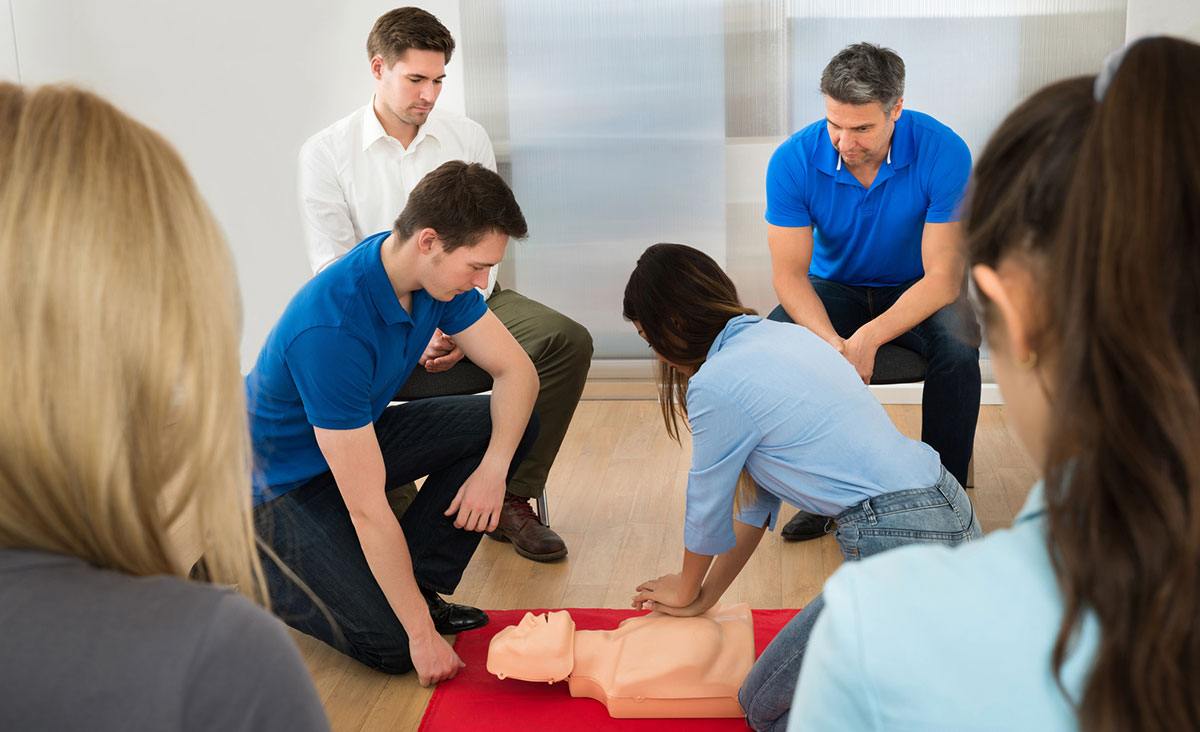
In Quebec, every employer must ensure that at least one workplace first aider is present at all times, on every work shift, and the required number increases with the number of people on site. This requirement comes from the Regulation respecting minimum standards for first aid and first assistance, and it applies equally to an office with 30 employees, a construction site, or a forestry operation.
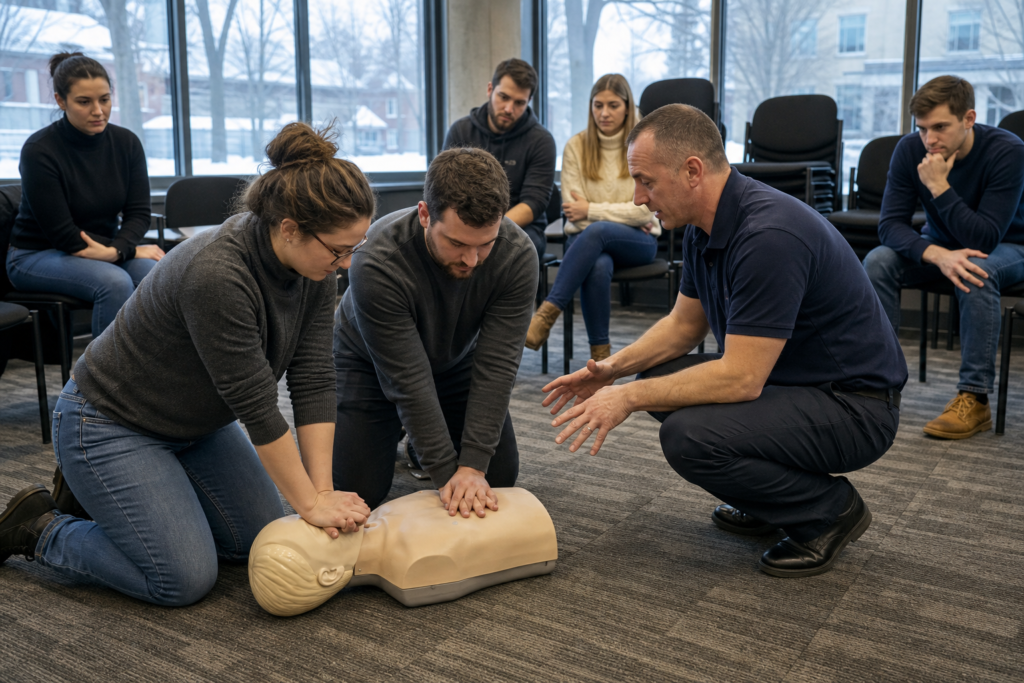
General workplace first aid training lasts 16 hours and concludes with a practical evaluation.
The Quebec regulation (A-3.001, r. 10) requires employers to provide three things: a sufficient number of trained first aiders, accessible first aid equipment, and a record of all first aid interventions. Section 3 specifies that first aid coverage must be ensured “at all times during working hours,” meaning every shift. An employer who has trained four people but schedules them all on the day shift is not compliant during the night shift.
The calculation is based on the number of people physically present at the same time. This distinction has become especially important with the widespread adoption of hybrid work. If four employees are in the office while thirty are working from home, only one first aider is required, but that person must actually be present on site. Volunteers present at the workplace are also included in the calculation.
The required thresholds vary depending on the type of workplace. A construction site is considered riskier than an office, and a forestry worksite is considered even more hazardous, which explains the stricter ratios.
| Workplace | People Present at the Same Time | Required First Aiders |
|---|---|---|
| Workplace (office, factory, business) | 50 or fewer | 1 |
| Workplace | 51 to 150 | 2 |
| Workplace | 151 and more | +1 for each additional 100 workers |
| Construction site | 10 to 50 | 1 |
| Construction site | 151 and more | +1 for each additional 100 workers |
| Forestry operation | 5 or fewer | 1 |
| Forestry operation | 11 and more | +1 for every additional group of 5 workers |
For forestry operations, the regulation also requires employers to train one additional person beyond the minimum requirement to cover absences. In the silviculture sector, the rule is even stricter: at least one worker out of every five must hold a valid first aid certificate.
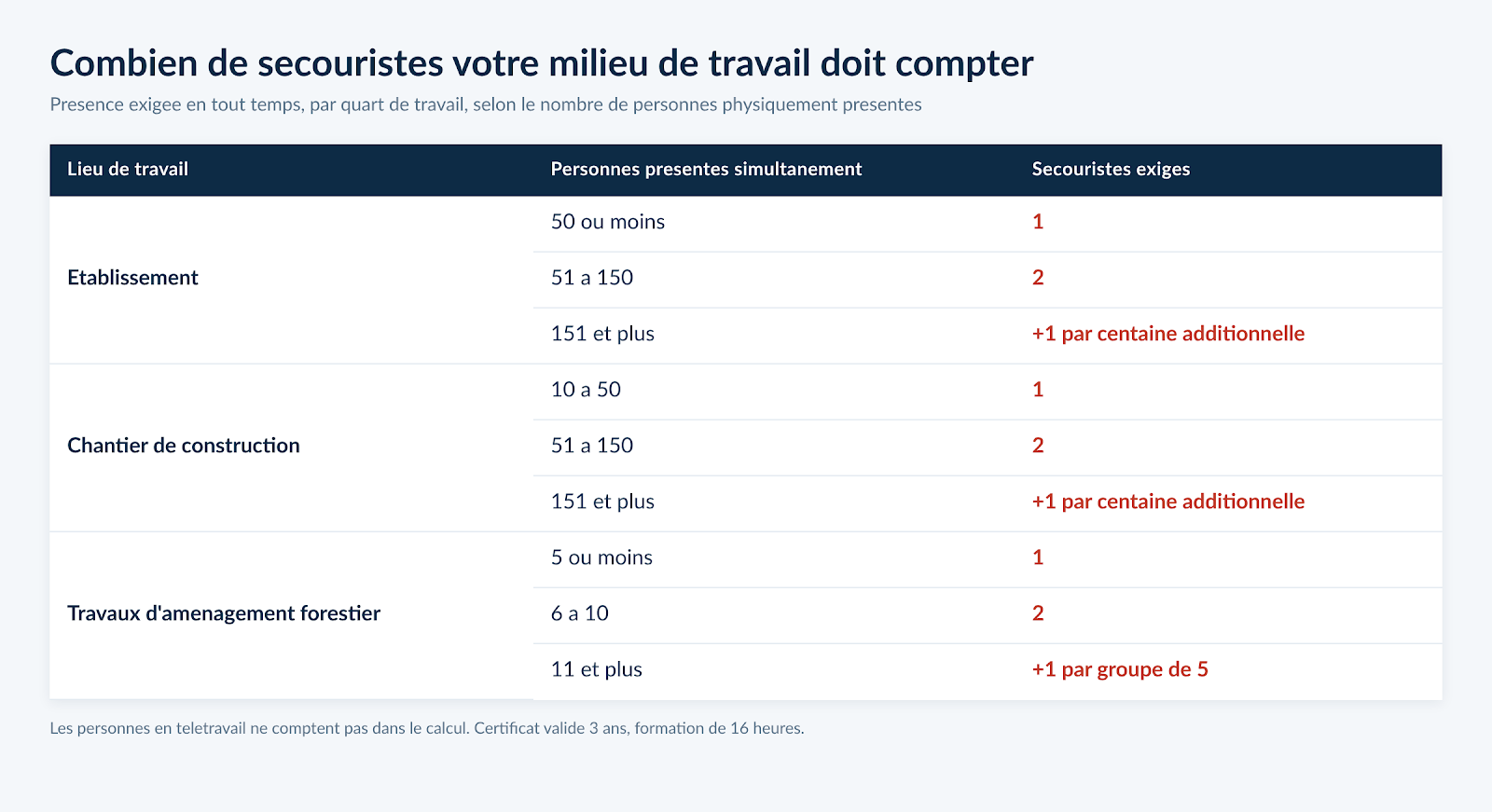
The number of first aiders required per work shift, based on the type of workplace and the number of people present.
The title is not obtained automatically. An employee earns it after completing a 16-hour training course that complies with the regulation, delivered by a recognized training provider, and successfully passing the practical evaluation. The course covers calling emergency services, assessing the victim, controlling bleeding, clearing airway obstructions, managing medical emergencies, and cardiopulmonary resuscitation (CPR) with an automated external defibrillator (AED). The curriculum follows internationally recognized scientific guidelines that are updated periodically (CPR & ECC Guidelines).
The certificate is valid for 3 years. After that period, the person no longer counts toward your legally required workforce, even if they are still employed by your company. This is the most common oversight: certificates all expire at the same time, three years after the initial training session. Our first aid and CPR programs are offered at our training centers or directly at your workplace, and you can register your employees in just a few minutes.
The course is delivered in a group setting, with a strong emphasis on hands-on practice. Participants train using manikins and simulated emergency scenarios because techniques such as chest compressions, airway management, and injury control cannot be mastered through theory alone. The evaluation measures both knowledge and practical skills, and passing it is what leads to certification.
Two practical considerations for businesses: the 16-hour course is generally scheduled over two consecutive days or four half-days, and part of the theoretical content may sometimes be completed online, depending on the chosen format. You should also check with the CNESST for available funding programs related to first aid training before planning your annual training schedule. See our list of business services and detailed training programs.
The number of first aiders is only one of the three required elements. Under occupational health and safety regulations, employers must also provide an adequate number of first aid kits, located as close as possible to the work area, easily accessible, and containing clean, complete, and unexpired supplies. A first aid kit must be checked after every use, and any used supplies must be replaced immediately.
| Item | What Is Required | Inspection Frequency |
|---|---|---|
| First aid kit | Complete contents, clean, with valid expiration dates | After every use, plus regular inspections |
| Accident, incident, and first aid log | Name of responder, victim’s name, date, time, care provided | After every intervention |
| List of first aiders | Posted in a visible location within the workplace | Whenever staffing or schedules change |
| Certificates | Valid and renewed before the 3-year expiration date | Annual review recommended |
The log serves two purposes: it demonstrates your compliance and documents minor incidents that may later become relevant to a claim. A bandage applied today and recorded in the log can support a claim six months from now.

Accessible first aid kit, complete and up-to-date supplies, and a readily available record book: the three essential workplace habits.
The regulation does not require employers to install an automated external defibrillator, and many stop there. The statistics, however, tell a different story. Approximately 60,000 out-of-hospital cardiac arrests occur every year in Canada—one every nine minutes—and only one in ten people survives (Heart & Stroke report). Health Canada reminds us that CPR combined with defibrillation within the first three minutes can increase survival chances by at least 75% (Health Canada).
Yet AED use by bystanders reaches only 13% in public places. A device that is poorly marked, locked away, or whose location is unknown to staff cannot save lives. Cardiovascular disease remains the leading cause of death worldwide, according to the World Health Organization.
The regulation establishes a minimum based on headcount, not on your actual workplace health and safety risks. In 2024, the CNESST recorded 96,721 workplace accidents, 107,124 occupational injuries in total, and 246 work-related deaths (Radio-Canada). Three questions are more valuable than simply checking legal compliance:
Psychological health is also part of workplace emergency preparedness. Psychological first aid training equips managers to respond following a traumatic event, a death, or a serious accident—an aspect not covered by the regulation.
Two per shift, since workplaces with 51 to 150 people present at the same time must have two first aiders. If those 100 employees are divided into two shifts of 50, one first aider is required on each shift.
Yes. Only people who are physically present in the workplace, on the construction site, or in the forest are included when calculating the required workforce.
Three years. Renewal requires completing a training course that complies with the regulation through a recognized organization, and it must be completed before the expiration date to avoid a gap in compliance.
Regular members in good standing of the Ordre des infirmières et infirmiers du Québec are recognized as first aiders when they are present in the workplace concerned.
No. The regulation does not require one. However, CPR combined with an AED during the first few minutes is the only intervention that truly changes the outcome of a cardiac arrest, making it a highly recommended investment.
Count your active first aider certificates for each shift, verify their expiration dates, and fill any gaps. Our team delivers workplace first aid courses throughout the province, either at your company or at one of our training centers. Contact us to schedule a session tailored to your work shifts.



